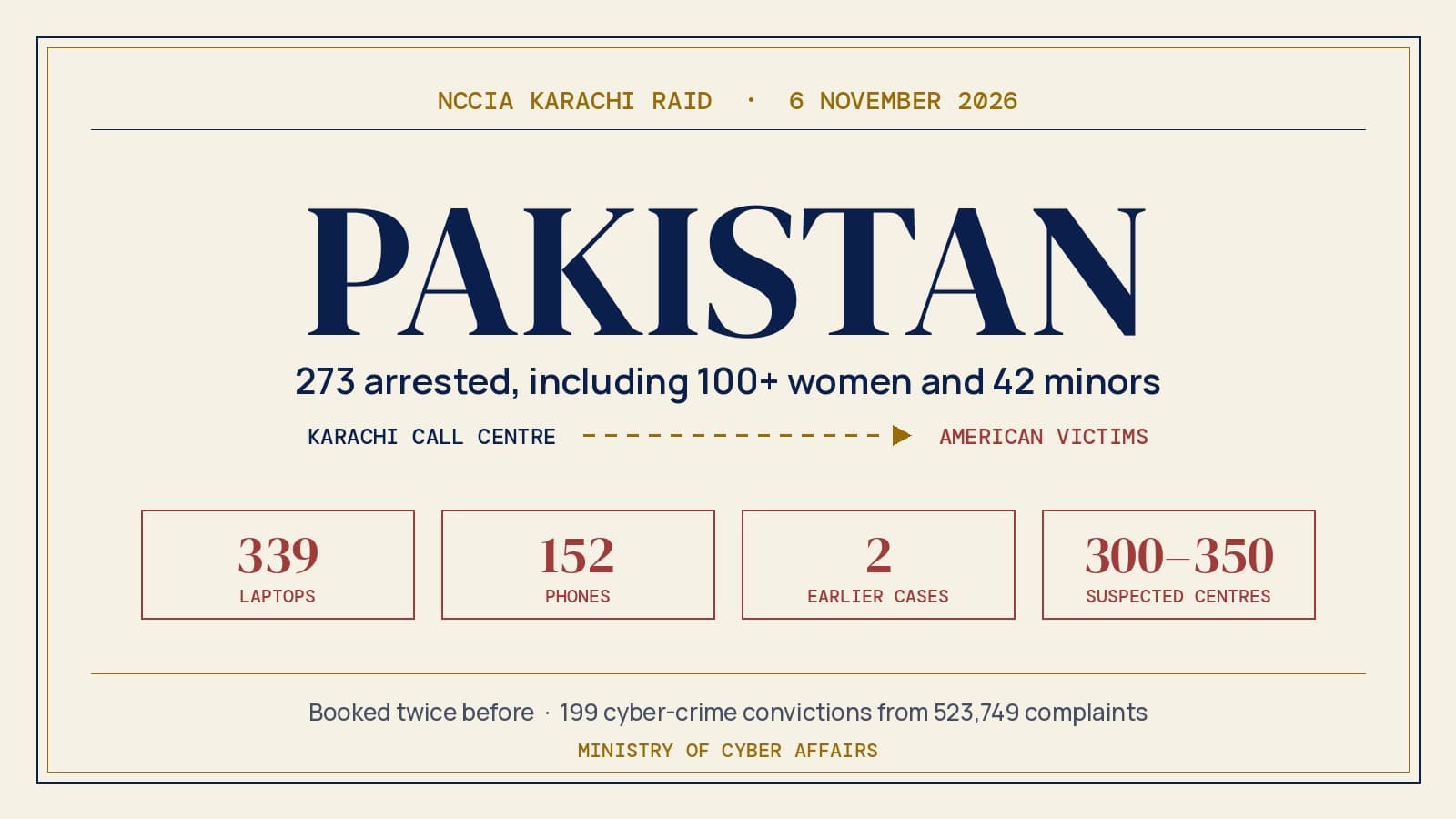
Pakistan's NCCIA arrested 273 people, including more than 100 women and 42 minors, at a Karachi call centre operating as Voxtron Solutions that allegedly scammed Americans, seizing 339 laptops, 152 phones and four CPUs. Additional Director Shahzad Akbar said the floor posed as a US debt-validation service, had faced two earlier criminal cases, and that 300 to 350 suspected scam centres still operate in Karachi. A court remanded nine suspects, including the alleged owners.
Pakistan's National Cyber Crime Investigation Agency arrested 273 people at a call centre operating as Voxtron Solutions near Kavish Crown Plaza on Karachi's Shahrah-e-Faisal, Additional Director Shahzad Akbar said. Those arrested included more than 100 women and 42 minors, boys and girls, according to Akbar as quoted by The Express Tribune. Investigators seized 339 laptops, 152 mobile phones and four CPUs.
NCCIA Karachi Zone announced the raid on 6 November 2026, spelling the brand "Voxstron". The Urdu post said foreign nationals were allegedly being defrauded through fake financial schemes, credit-card offers and callers who posed as representatives of financial institutions. It said a case had been registered under the relevant provisions of the Prevention of Electronic Crimes Act and that forensic analysis of the digital evidence was continuing. Dawn, The News and Arab News, reporting Akbar's press briefing, identified the floor as Voxtron Solutions and said the agency dated the operation to 4 November. Eyewitnesses quoted by The Express Tribune said the raid began around 8pm to 9pm on 3 November.
 The agency's own 37-second video, attached to that post, shows packed rows of cubicles beneath painted US dollar bills, a wall-sized map of the United States and the slogan "Imagine, Believe, Achieve". The clip carries a soundtrack but no intelligible speech.
A debt-validation script aimed at the United States
Akbar said preliminary findings indicated the floor was operating under the pretext of providing debt-validation services. Callers impersonated representatives of foreign banks and debt-validation firms, contacted people abroad and offered to verify outstanding financial obligations, he told reporters, Dawn reported.
Investigators said they had "reasonable grounds" to suspect the scheme was designed to induce victims into disclosing Social Security Numbers and payment-card credentials, including card expiry dates and CVVs, The News reported, and that the data was then used for unauthorised transactions through merchant accounts. Proceeds were reportedly moved to Pakistan through company accounts and remittance channels.
The News, citing the contents of the first information report, said callers used a cloud-based dialer and a customer-relationship portal, worked from prepared scripts and rebuttals, and posed as representatives of US debt-resolution agencies and regulated financial institutions of the United States. Social Security Numbers, mobile numbers, dates of birth and credit-card credentials were allegedly passed to the owner through the portal and then shared with merchants who processed unauthorised charges. Akbar told Arab News that card data was handed to merchants linked to companies registered in the United States, that a merchant had been identified in this case, and that investigators were examining those transactions.
None of the official briefings named the United Kingdom, Australia or Canada as victim countries in this raid, and none said any foreign national was among the 273 people arrested.
ARY News separately reported that callers used credit-card schemes and low-interest loan offers, mainly against retired people; that staff had daily targets of 15 to 20 contacts; and that the alleged fraud ran to "billions of dollars" over more than a year. NCCIA's posted statement and Dawn's account of the press conference did not give a loss figure or those daily targets. Those ARY claims have not been independently verified.
Nine, including the alleged owners, remanded for two days
The News reported that the FIR named Syed Usman Shamsi and his brother and alleged co-owner, Syed Asim Shamsi, both of Karachi, as involved in the suspected activity at the call centre. NCCIA and Dawn's courtroom reports did not publish the two men's ages or parentage beyond describing them as brothers. They have not been convicted.
On 5 November the investigating officer produced the 273 detainees before Judicial Magistrate (East) Gulraiz Memon by video link, after submitting a Sindh Home Department notification that declared the call-centre premises a temporary sub-jail, Dawn reported. The officer told the court he needed physical custody of only nine suspects, including the owners.
The court remanded those nine to NCCIA for two days and sent the remaining men to prison on judicial remand. It granted bail to 98 women and two juvenile boys, subject to NADRA age verification, against surety of Rs 5,000 each (about US$18), Arab News and Dawn reported. Defence lawyers Shahab Sarki and Ali Akbar Poonawala argued that most of those held were women or underage and that the offences were bailable.
The numbers around age and gender do not line up cleanly:
- Akbar said about 100 women and 42 teenagers, including boys and girls, were among those involved, The News reported. The Express Tribune quoted him as saying more than 100 women and 42 underage boys and girls.
- Arab News reported that the company's recruitment advertisements required applicants to be at least 18, but that Akbar alleged younger workers had been hired to cut labour costs.
- Defence counsel told the magistrate that more than 70 juveniles and over 80 women were among those arrested, The Express Tribune reported. That is not the breakdown the court recorded when it granted bail.
- ARY News reported that around 42 employees did not have national identity cards. That figure has not been confirmed by the court record cited in Dawn.
Express News reported that NCCIA Karachi Zone said the arrests were made under FIR number 122/2026.
Dawn said the case was registered under Sections 3 (unauthorised access to an information system or data), 4 (unauthorised copying or transmission of data), 13 (electronic forgery), 14 (electronic fraud), 16 (unauthorised use of identity information) and 26 (spoofing) of the Prevention of Electronic Crimes Act, 2016. The News described the same sections as belonging to the Act as amended in 2025.
Families and residents protested near Baloch Colony Bridge on Shahrah-e-Faisal against the arrest of around 100 women, saying the workers had no role in illegal activity, Dawn reported. Traffic was restored at 1:22pm.
The investigating officer in this case was not named in the reports reviewed for this article. The only NCCIA officer publicly credited at the Karachi briefing was Additional Director Shahzad Akbar. Akbar also said parents of children found involved could be examined under Section 109 of the Pakistan Penal Code. There was no report that any parent had been charged.
Booked twice, then open again on the main road
This was not a hole-in-the-wall operation. It sat near Kavish Crown Plaza on Shahrah-e-Faisal, Karachi's principal commercial artery, with hundreds of seats, hundreds of laptops and walls decorated for a US-facing sales floor. Akbar told Arab News the raid followed a local tip, not a request from a foreign government or an overseas law-enforcement agency.
He also said the company had already faced two earlier criminal cases, and that investigators had previously booked only the owners and left skilled employees free to resume work. "The problem is that when employees are not booked, they remain free, and they are the ones who possess the specific skills required to carry out these activities," he told Arab News. Relatives could restart the same floor under a new company name, he said, and mismatches between registered business identities and trading names made the network harder to map.
The Express Tribune quoted him as saying this was the first time employees had been nominated along with the owner, and that the company was among the top three scam call centres in Karachi. ARY News reported that the centre had been raided in 2025, after which a case was registered against the owners and management and the staff were released. That earlier case file has not been published alongside this raid.
Akbar's own contrast undercuts any suggestion that the floor was invisible. He told Arab News that many scam crews now work from houses or moving cars, with four or five people and an internet link, which makes them hard to find. On the agency's evidence, Voxtron was the opposite: a large, fitted-out office on the city's most watched road, running what NCCIA says was a harvest of US Social Security Numbers through company accounts and remittance channels. That leaves a question the raid does not answer: how landlords, banks handling those company and remittance flows, telecoms carrying the call volume, and the authorities that register companies and export-oriented IT businesses treated a 339-laptop "debt-validation" shop as ordinary commerce.
One week earlier, NCCIA arrested 47 people at an alleged scam centre on the fourth floor of Technology Park, Shahrah-e-Faisal, according to Dawn's report of 29 October 2026. Five suspects were then still missing. A case was registered against 52 people. Investigating officer Ameer Ali brought the 47 before the same magistrate, Gulraiz Memon, who gave the agency three days' physical remand. The agency seized 50 laptops, 26 mobile phones and one desktop computer.
A string of raids, and almost no convictions
The Karachi floor sits in a much longer list of NCCIA call-centre actions.
In July 2025 the agency arrested 149 people at a compound in Faisalabad, including 48 Chinese nationals and workers from Nigeria, the Philippines, Sri Lanka, Bangladesh, Zimbabwe and Myanmar, Dawn and the BBC reported. The premises were linked to Malik Tehseen Awan, a former chairman of the Faisalabad Electric Supply Company board, who was arrested later that month.
In May 2025, NCCIA arrested 21 people in Lahore's Bahria Town and in Multan over Heartsender, a phishing and malware service rather than a call floor. KrebsOnSecurity, citing Dawn, reported that NCCIA Director Abdul Ghaffar said the tools were tied to more than US$50 million in losses in the United States, after the FBI and Dutch police seized the infrastructure in January 2025.
On 29 September 2026, NCCIA Rawalpindi arrested 61 people at a loan-recovery call centre in Commercial Market, Satellite Town, and seized 155 laptops and 71 phones, Dawn reported. Director General Syed Ali Nasir Rizvi called illegal call centres "a major threat to the country's reputation and public trust". Dawn noted that a day earlier the agency had arrested more than 70 people in two raids on call centres in Karachi's PECHS area, alleged to have targeted people in the United States with new credit-card and low-interest offers.
In August 2026, NCCIA arrested 114 foreign nationals in Islamabad, 111 of them Chinese and three Vietnamese, over an alleged cyber-romance and image-based blackmail network run from a registered IT business, Dawn reported.
Associated Press of Pakistan reported on 24 October 2026 that Additional Director Shoaib Khan said NCCIA Islamabad had arrested 671 suspects, 473 of them foreign nationals, in raids on 16 call centres and had seized about 13,000 devices.
On 7 October 2026, NCCIA Rawalpindi raided the Abbasi Call Center on Chakri Road, which The News said was using Telegram to target Australian citizens with fake tasks and USDT investment schemes.
On 10 October 2026, NCCIA Lahore Additional Director Atif Ameer said a raid in Johar Town Phase-I had arrested 37 people who allegedly posed as US and Canadian mobile providers to harvest card details. The alleged owner, Hafiz Ali Ahmad, was not present, Dawn reported. Ameer said the same week had brought 281 arrests, including 21 foreign nationals, from eight illegal call centres.
On 3 November 2026, around the same window as the Karachi raid, Ameer's Lahore team arrested eight people, including two women, at a Township call centre that NCCIA said was running an "AT&T campaign" against British citizens, Dawn reported.
The pattern is not a shortage of raids. It is what happens after them. An official document presented in Pakistan's National Assembly, as reported by ProPakistani on 21 May 2026, said NCCIA received 523,749 cybercrime complaints between 2023 and 2026 and secured 199 convictions, about 0.038 percent of complaints. The same document said the agency registered 5,755 cases, arrested 7,600 people and recorded 877 acquittals. In 2025 it logged 157,465 complaints and 39 convictions, against 2,916 arrests. The 2026 figures in that table, covering only part of the year, were 77,023 complaints, 520 arrests and eight convictions.
Those ratios will not close a market that Akbar himself puts at 300 to 350 suspected scam call centres in Karachi, with the rest of the country still to count.
The money trail and the export brand
Pakistan was removed from the Financial Action Task Force's increased-monitoring list, commonly called the grey list, on 21 October 2022, after completing 34 action items, the FATF said. Four years later, NCCIA is describing US card data moving through US-linked merchant accounts, Pakistani company accounts, formal remittance channels and, Akbar told The News, hawala and hundi. The agency has not yet published the value of those flows in the Voxtron case, the names of the merchant companies, or what the banks that handled the company and remittance accounts reported, if they reported anything.
That gap matters beyond the 273 people now cycling through bail and remand. The State Bank of Pakistan recorded IT and telecom export remittances of US$4.6 billion in fiscal year 2025-26, Business Recorder reported in July 2026, a record, and still short of the government's US$5 billion target. Illegal floors that look like ordinary call-centre or BPO offices, sit on the main commercial road and hire in the hundreds are a direct threat to that figure, a point NCCIA's own director general has already made about the country's reputation.
A raid of this size is evidence that the agency can fill a floor when it chooses to. It is not evidence that Karachi's call-centre economy has been dismantled, or that the people who financed, registered and banked this one will see a courtroom outcome any stronger than the two cases that, on NCCIA's own account, failed to keep it closed.