Meta suicide alert helps UP Police rescue Bareilly youth within 10 minutes
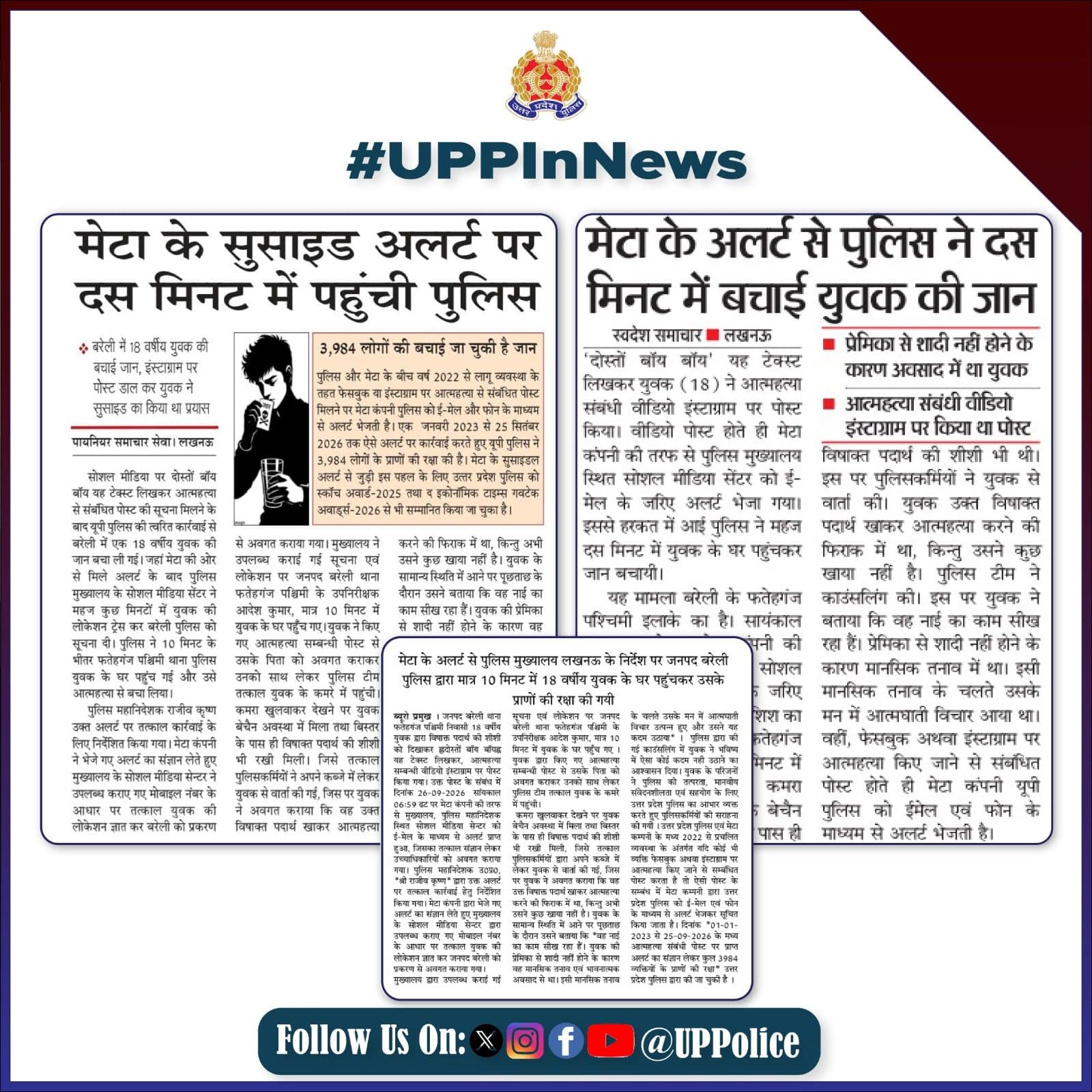
UP Police rescued an 18-year-old in Bareilly within 10 minutes after Meta flagged his Instagram self-harm post and alerted the force’s Social Media Centre. Brief on how Meta’s suicide-risk warning system works with police. Source: @Uppolice.
Uttar Pradesh Police say they prevented a suicide in Bareilly after Meta’s real-time self-harm alert reached the force’s Social Media Centre and local officers arrived at the young man’s home within about 10 minutes.
According to Hindi press clippings shared by the official @Uppolice account (29 September 2026), an 18-year-old from the Fateganj Pashchim area had posted a distress video and a “Bye-bye friends” message on Instagram while in acute mental distress over a relationship.
Meta’s systems flagged the content as suicide-related and immediately notified UP Police headquarters.
Details and location were passed to Bareilly district police.
A team led by Sub-Inspector Aadesh Kumar reached the house quickly, found the youth in a restless state with means of self-harm nearby, stopped the attempt, counselled him and informed his family.
The force framed the case under #EveryLifeMatters and #DigitalSentinels, highlighting coordination between platform safety systems and on-ground response.
How Meta’s suicide warning system works (brief)
Meta monitors Facebook and Instagram for posts, videos and related signals that suggest a credible risk of suicide or self-harm.
When such content is detected, the company can escalate in two main ways that matter for this story:
- Law-enforcement / emergency referral. Meta can send a live alert to partnered police or emergency services so responders can attempt a wellness check. In Uttar Pradesh, that path is described as a real-time notice (including by email and phone) to the Police Social Media Centre, often with registered mobile and location cues that help local units reach the person. Globally, Meta has said that when it becomes aware of posts suggesting a credible suicide risk on Facebook and Instagram, it alerts emergency services; it reported more than 19,000 such referrals worldwide in the previous year.
- Parent / guardian alerts (Meta AI and Instagram supervision). Separately, Meta has expanded teen-safety tools so parents using Instagram supervision can be notified if a teen’s chat with Meta AI shows signs of suicide or self-harm risk (signals developed with clinicians; flagged chats are manually reviewed before an alert). Those parent alerts are live in the US, UK, Australia and Canada, with a wider rollout planned. Meta is also building ways to contact emergency services when a Meta AI conversation itself suggests imminent risk. Supervising parents already receive alerts if a teen repeatedly searches Instagram for suicide or self-harm terms in a short period.
In the Bareilly case, the operational path that saved time was the first one: platform detection to UP Police Social Media Centre to district response.
Impact claimed in UP
One of the clippings shared by UP Police states that 3,984 lives have been saved through this Meta–police alert pathway since 1 January 2023.
The same coverage notes that the force has received recognition including a SKOCH Award and an Economic Times Governance Award for the initiative.
Those figures and awards are reported as cited in the press material amplified by @Uppolice; independent verification of the cumulative count was not separately published in the post itself.
Why it matters
Minutes matter in suicide-crisis response.
The Bareilly rescue shows how automated detection on a major social platform, paired with a staffed state social-media cell and fast local policing, can turn an online distress signal into an offline intervention.
It also underlines the dual nature of Meta’s warning stack: public-post emergency referrals that link to police, and family-supervision / Meta AI alerts aimed at getting teens offline support sooner.
Peer-reviewed work has repeatedly linked heavy Instagram use with higher depressive symptoms among young people, though researchers stress correlation and pathways rather than a single simple cause.
A systematic review of Instagram studies on youth (Translational Medicine Communications, 2021) found a consistent association with depressive symptoms or depressive behaviour, moderated by factors such as social comparison, self-esteem tied to likes and approval, gender, and negative or thin feedback.
Earlier work in Cyberpsychology, Behavior, and Social Networking (Lup, Trub and Rosenthal, 2015) reported that more frequent Instagram use was tied to greater depressive symptoms especially among users who follow many strangers, via negative social comparison with idealised feeds.
Related surveys similarly find that upward comparison while browsing curated photos and status updates can mediate the link between time on Instagram and depressed mood.
That research context helps explain why platform self-harm detection and fast police or family intervention matter: high-intensity Instagram use can coincide with vulnerability, and distress that spills into public posts needs offline support, not only an algorithmic feed.
If you or someone you know is in crisis in India, contact local emergency services (Dial 112) or a recognised mental-health helpline.