Kantara Actress Rukmini Vasanth Files Cybercrime Case Over AI-Generated Deepfakes; Three Arrested
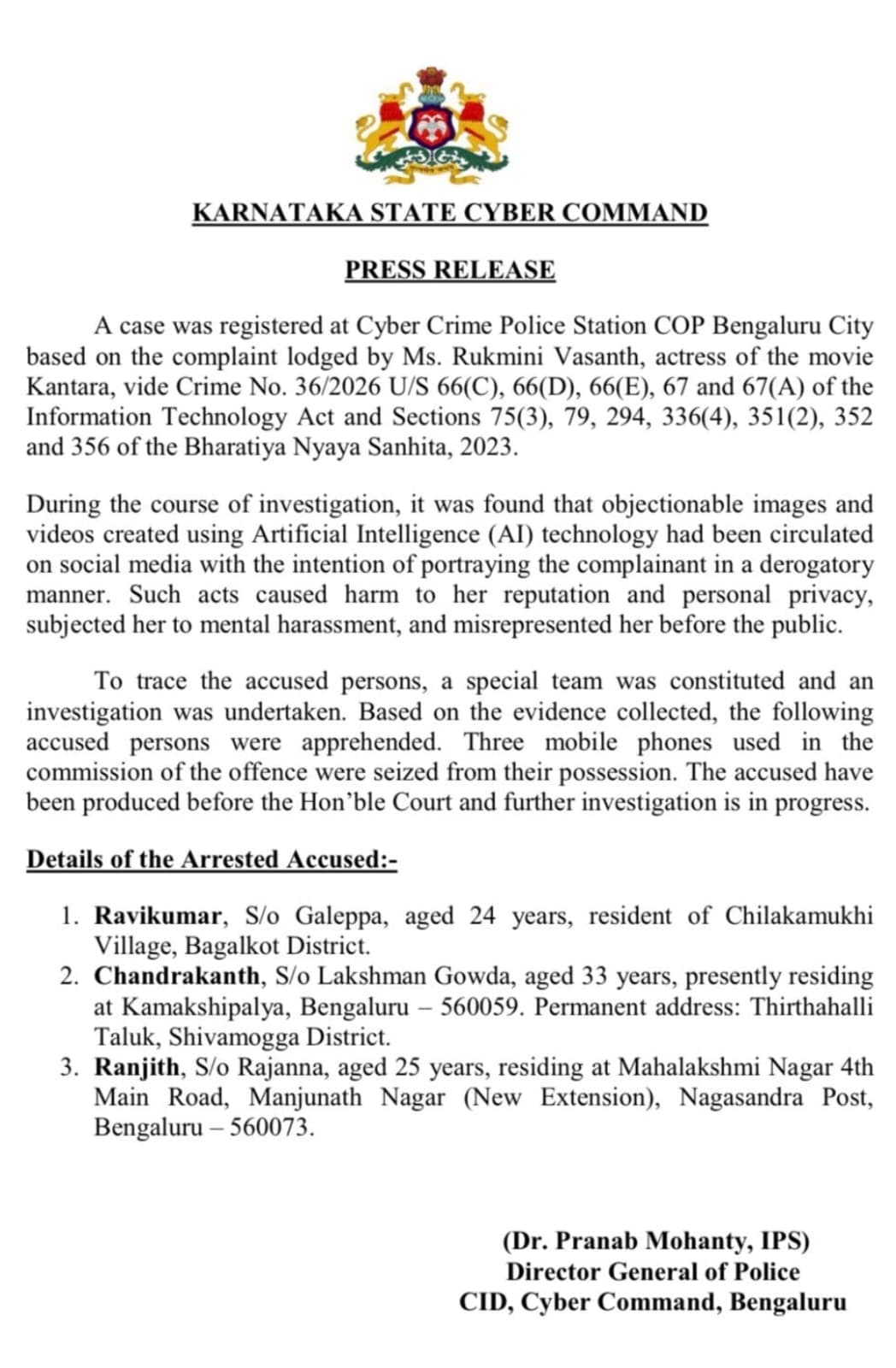
Karnataka's Cyber Command says investigators traced a special team to apprehend three accused in a case that has alarmed the film fraternity. AI was used to create objectionable images
BENGALURU, In a case that strikes at a growing fear across the entertainment industry, actress Rukmini Vasanth, known for her role in the blockbuster Kantara, has filed a complaint with the Karnataka State Cyber Command after objectionable images and videos of her, allegedly fabricated using artificial intelligence, were circulated on social media.
According to a press release issued by the CID's Cyber Command, a case was registered at the Cyber Crime Police Station, Bengaluru City (Crime No. 36/2026), under multiple sections of the Information Technology Act, including 66(C), 66(D), 66(E), 67 and 67(A), alongside several provisions of the Bharatiya Nyaya Sanhita, 2023.
Investigators found that the AI-generated content was circulated "with the intention of portraying the complainant in a derogatory manner," causing harm to her reputation and privacy, and subjecting her to mental harassment, the release stated.
A special team was constituted to trace those responsible. Three accused have since been apprehended and produced before the court, with three mobile phones seized as part of the investigation, which remains ongoing. The release was issued under the authority of Dr. Pranab Mohanty, IPS, Director General of Police, CID, Cyber Command.
Why the industry is watching
For actors, the case lands close to home. Deepfake technology, capable of grafting a person's likeness onto fabricated imagery with unsettling realism, has rapidly become one of the most pressing threats to public figures, and women in cinema have been disproportionately targeted. Over the past two years, several prominent Indian actresses have spoken out after finding their faces manipulated into explicit or defamatory content.
What makes the Kantara actress's case notable is the swift police action and the use of newer legal provisions to pursue it. Industry observers say arrests in deepfake cases remain rare, and a traceable prosecution could set a meaningful precedent for how such offences are handled.
For an industry whose currency is image and reputation, the message is pointed: the tools that threaten performers are evolving fast, but so, increasingly, is the response.
This is a developing story. The accused are under investigation and have not been convicted; all are entitled to the presumption of innocence.