India Cracks Down on Mule Accounts: Is Your Account a Laundering Tool?
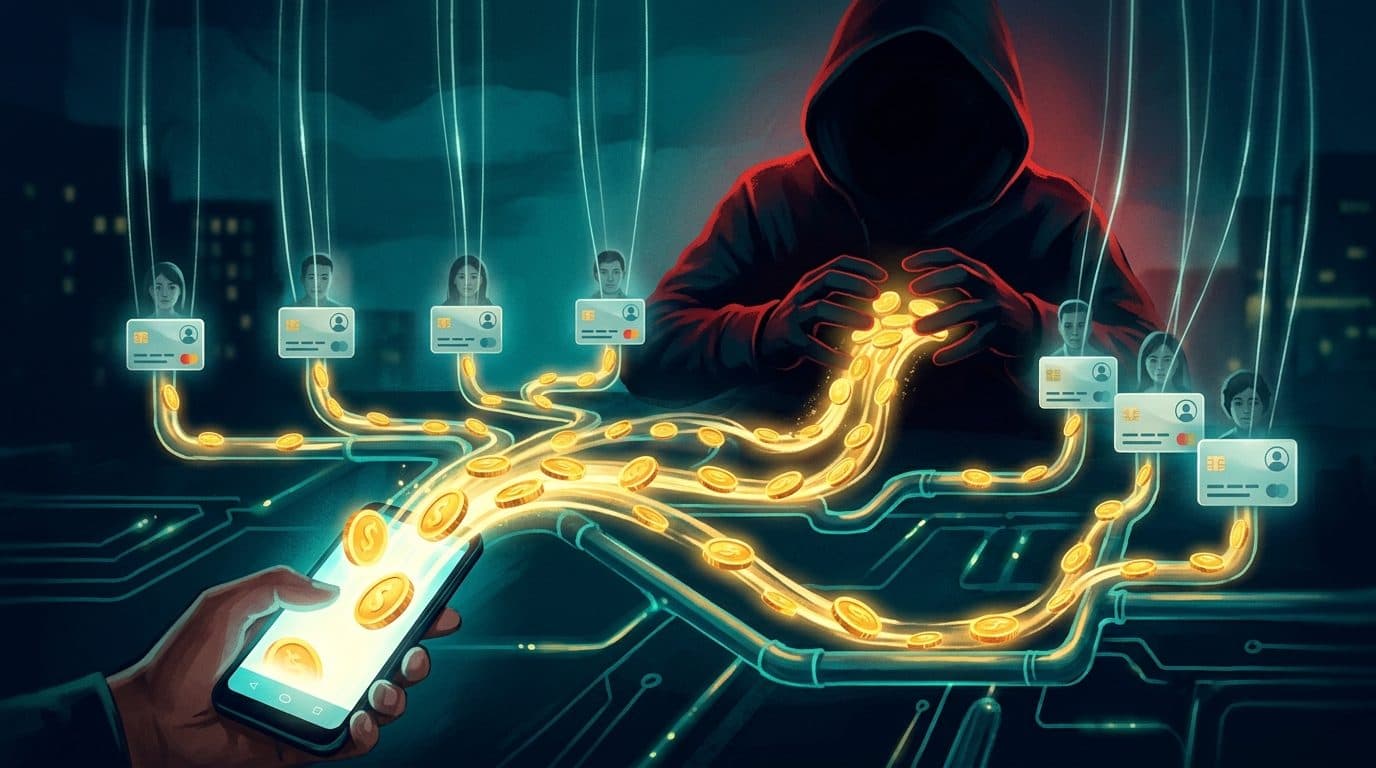
A mule account moves criminal money through an innocent person's bank account. In India, renting or lending yours is a crime — even unknowingly. How the scam works and how to avoid it.
A stranger messages you with an easy offer: let some money pass through your bank account, keep a small cut, do nothing else. Or a “part-time job” asks you to “process payments” from home. It sounds harmless — even clever. It is, in fact, one of the fastest ways an ordinary person in India ends up with a frozen account, an FIR, and a police investigation. Welcome to the world of the mule account — the hidden plumbing that makes almost every cyber fraud possible.
A mule account is a real bank account used to move criminal money. In India, selling, renting, or lending your bank account — even if you didn’t know what the money was for — is a crime. Account holders are legally responsible for every transaction that flows through their account, regardless of intent. “Ignorance of the law is no defence.”
What is a mule account?
When criminals steal money — from a phishing victim, a “digital arrest,” an investment scam — they cannot leave it in one place, because police can trace and freeze it. So they move it fast, through a chain of innocent-looking accounts, before cashing it out. Each account in that chain is a mule account, and the person whose name is on it is the “money mule.”
The stolen funds typically pass through layers: a victim’s money lands in a “first-layer” account, is split and forwarded to second- and third-layer accounts within minutes, and is finally withdrawn as cash at an ATM or converted to crypto — erasing the digital trail. The mule provides the one thing criminals can’t easily fake: a genuine, KYC-verified bank account in a real person’s name.
How ordinary people get recruited
Almost no one signs up to launder money. They are tricked, with offers engineered to feel legitimate or trivial:
- “Easy commission” — receive money and forward it, keep a percentage.
- Fake part-time / work-from-home jobs — “payment processing” or “finance assistant” roles that just route funds.
- “Rent your account” — a flat fee to let someone use your account “for a few transactions.”
- Quick-loan and task scams — apps and Telegram groups that ask for account access as a condition.
- Romance and friendship — an online partner who needs to “park” money with you.
The targets are predictable: students, gig workers, small traders, daily-wage earners, and unemployed youth — people for whom a small fee matters and the legal risk is invisible.
Why it is so dangerous — for you
The moment your account is used to move fraud proceeds, you are the name attached to a crime. The consequences are severe and immediate:
- Criminal liability under the IT Act, the Bharatiya Nyaya Sanhita (BNS), and the Prevention of Money Laundering Act (PMLA).
- Your account is frozen — halting salary credits, business payments, and daily expenses.
- You can be named in an FIR and arrested, even if you never met the criminals.
- Lasting damage: harmed credit score, blocked employment prospects, and complications with passport, visa, and foreign travel.
Because the law holds you responsible regardless of whether you knew, “I didn’t realise” is not a shield.
India’s crackdown is accelerating
Authorities have made mule accounts a priority. In Operation Mule Hunt 1.0, Gujarat Police’s Cyber Centre of Excellence dismantled a network handling an estimated ₹2,289 crore in illicit transactions — registering 565 FIRs, making 638 arrests, and acting against 913 mule accounts later linked to 4,052 cybercrime cases across India. Freezing “first-layer” accounts cut active suspect accounts by about 30%, and ATM cash-outs fell 66% during the crackdown’s final quarter.
The detection is going automated, too. On 12 May 2026 the Indian Cyber Crime Coordination Centre (I4C) and the Reserve Bank Innovation Hub (RBIH) signed an agreement to combine I4C’s Suspect Registry and the NCRP with RBIH’s AI platform, MuleHunter.ai, to flag suspicious accounts from their transaction patterns. The net is tightening.
How to protect yourself
- Never let anyone use your bank account — not for a fee, a favour, a friend, or a “job.” There is no safe version of this.
- Treat “easy money to receive and forward” as a crime, not an opportunity. Legitimate jobs never route money through your personal account.
- Be wary of part-time roles that ask for your account details or bank access during “onboarding.”
- Warn the vulnerable — students and first-job seekers are prime targets. Tell them before a recruiter does.
- If your account is already involved, stop all activity, preserve the messages, and report to 1930 / cybercrime.gov.in immediately — coming forward early is far better than being found.
Frequently asked questions
Is renting my bank account actually illegal if I didn’t commit the fraud?
Yes. Indian police have warned that selling, renting, or allowing someone else to use your account is itself a criminal offence — you are responsible for transactions through your account regardless of intent or awareness.
What happens to a money mule’s account?
It is typically frozen during investigation, and the holder can face an FIR and prosecution under the IT Act, BNS, and PMLA.
I think I was tricked into being a mule. What should I do?
Stop using the account, keep all evidence of how you were recruited, and report to 1930 and cybercrime.gov.in proactively. Early cooperation matters.
The bottom line
A mule account turns an innocent person into the visible face of an invisible crime. The criminals stay hidden; the mule’s name is on the FIR. With AI detection like MuleHunter.ai now scanning for exactly these patterns, the “easy money” has never been more likely to end in a frozen account and a court date. The rule is simple: your bank account is yours alone — never let anyone else use it.