How Law Enforcement Can Request ChatGPT User Data via OpenAI Kodex (LERS Portal)
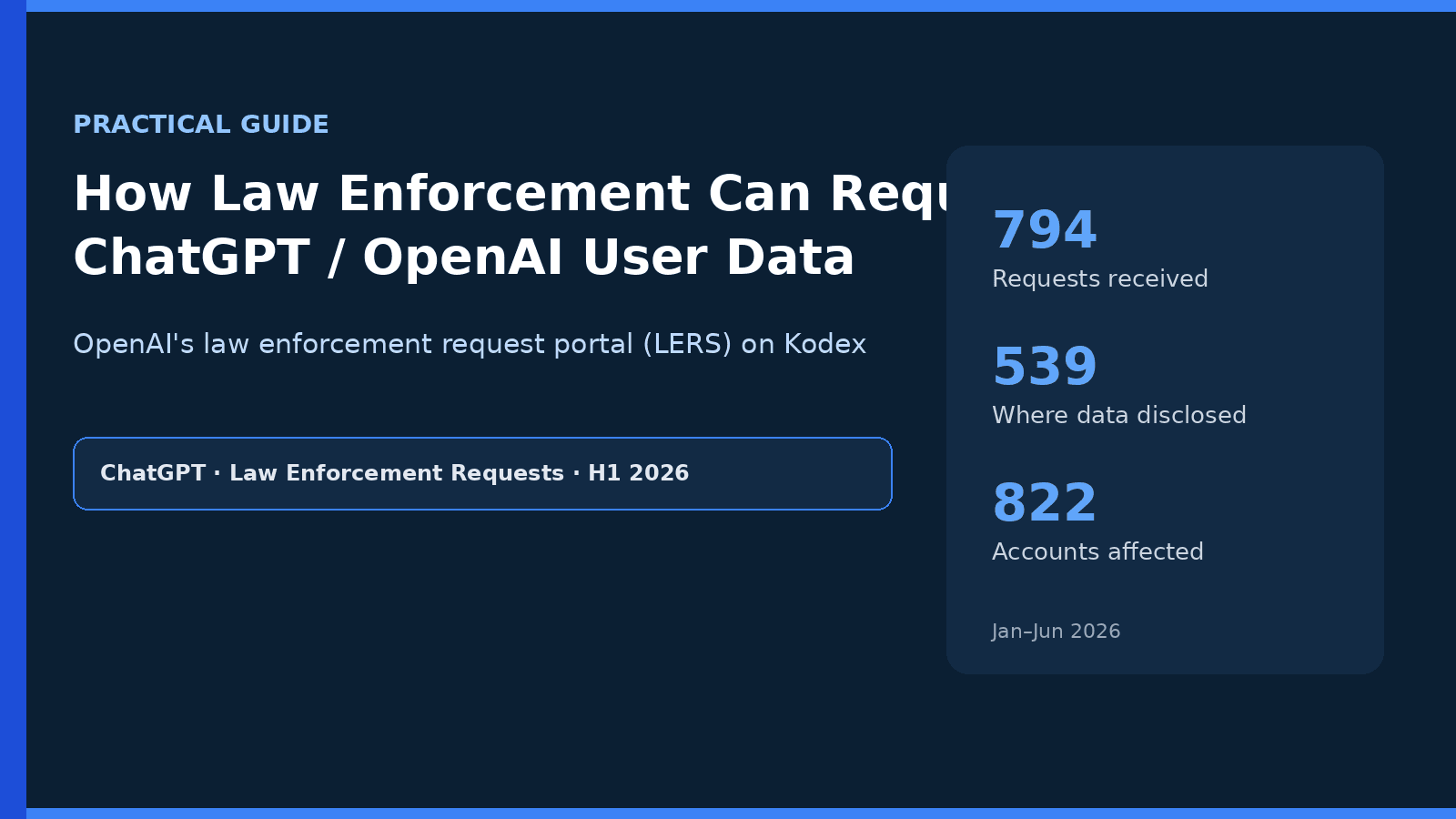
A practical guide to OpenAI law enforcement requests for ChatGPT user data: non-content, content and emergency categories; H1 2026 disclosure figures; and how to submit through OpenAI's law enforcement request portal (LERS) on Kodex, with warrant, MLAT and user-notice rules from OpenAI policy.
OpenAI's Government User Data Request Policy and H1 2026 transparency report explain how agencies can seek ChatGPT / OpenAI account information through lawful process. The practical submission route is OpenAI's law enforcement request portal (LERS) on Kodex, a generic shorthand for that government workflow, not an OpenAI product name.
What an OpenAI law enforcement request can cover
A. Non-content data, The report lists name, email address, payment information, and transaction history. For OpenAI US, the policy requires a subpoena, court order, search warrant, or equivalent.
B. Content data, Legal process such as search warrants for text or files input or output with OpenAI services (prompts/inputs, generated responses, uploaded or generated files). For OpenAI US, content is disclosed only on a valid warrant or equivalent.
C. Emergency requests, Limited disclosures where OpenAI believes data is needed to prevent an emergency involving death or serious physical injury. Requests are case-by-case and must show the threat, urgency, and why ordinary process cannot be obtained in time.
Government requests: January–June 2026
Request type | Received | Disclosed | Accounts |
|---|---|---|---|
Non-Content | 620 | 441 | 679 |
Content | 146 | 88 | 130 |
Emergency | 28 | 10 | 13 |
Total | 794 | 539 | 822 |
- Non-Content, received 620; disclosed 441; accounts 679
- Content, received 146; disclosed 88; accounts 130
- Emergency, received 28; disclosed 10; accounts 13
- Total, received 794; disclosed 539; accounts 822
Separately: 250–499 U.S. national security requests (FISA/NSLs) affecting 250–499 accounts, excluded from the table.
Requests to OpenAI rose from 71 to 794 in 18 months

Government requests for user data received by OpenAI have grown more than elevenfold across its last four transparency reports, while the share in which data was disclosed stayed between 68% and 76%:
- H2 2024: 71 requests, 54 with data disclosed (76%)
- H1 2025: 146 requests, 105 disclosed (72%)
- H2 2025: 309 requests, 209 disclosed (68%)
- H1 2026: 794 requests, 539 disclosed (68%)
Requests more than doubled in the latest six months alone, rising 157% from 309 to 794. Totals exclude U.S. national security requests, which OpenAI reports only in ranges.
How to submit via the ChatGPT / OpenAI LERS portal on Kodex
Portal: https://app.kodex.us/openai/signin
All government user-data requests to OpenAI US or OpenAI Ireland must go through Kodex. OpenAI's Kodex help article (title emphasises content removal; body also covers User Data) says:
- Sign in with a verified government account.
- Select the OpenAI entity (OpCo, LLC outside EEA/Switzerland; Ireland Ltd. for EEA/Switzerland).
- Choose User Data for an OpenAI law enforcement request (Content Removal is for takedowns only).
- Attach required legal process.
- Identify the account unambiguously.
- Specify data categories and time period.
What investigators should include
Policy minimums: valid enforceable process; officer name/contact; particular record categories; production date if needed; unambiguous account ID; specific time period. Add case/agency references and a short necessity note so the packet matches the process. Emergencies also need the emergency facts, why process cannot wait, and how the data averts the harm.
Legal-process rules that matter internationally
- OpenAI US: non-content via subpoena/court order/warrant/equivalent; content via warrant/equivalent.
- Non-U.S. to OpenAI US: possible direct foreign process if compulsory in the requester's country and consistent with U.S. law/OpenAI policy; otherwise MLAT, CLOUD Act § 2523 agreements, letters rogatory, or similar routes that yield U.S. process.
- OpenAI Ireland: Irish judicial order for Irish authorities; non-Irish agencies use diplomatic/MLA Irish process.
- User notice before disclosure unless prohibited by law; limited exceptions; possible delayed notice.
- Preservation (OpenAI US): up to 90 days under 18 U.S.C. § 2703(f), plus 90-day extension. Without preservation, records may not be retained in the normal course of business.
Technical records not itemised in the transparency tables
The H1 report does not list IP addresses, login history, device identifiers, session logs, geolocation, deleted conversations, or API usage logs as separate categories. Confirm availability and required process via Kodex, and preserve early where the policy allows.
Official resources
- Transparency: https://openai.com/trust-and-transparency/
- Policy: https://cdn.openai.com/pdf/openai-law-enforcement-policy-v.2025-12.pdf
- Kodex portal: https://app.kodex.us/openai/signin
- Kodex guidance (content removal + user-data paths): https://help.openai.com/en/articles/20001621-submitting-government-content-removal-requests-with-kodex
- H1 2026 report: https://cdn.openai.com/trust-and-transparency/report-2026h1-government-requests-for-user-data.pdf
FAQ
Q: Where do I submit a ChatGPT user-data law enforcement request? A: Kodex at https://app.kodex.us/openai/signin, correct OpenAI entity, User Data path.
Q: Do I need a warrant for ChatGPT content? A: For OpenAI US, yes, a valid warrant or equivalent; non-content may use a subpoena, court order, warrant, or equivalent.
Q: Can a non-U.S. agency request OpenAI US data directly? A: Sometimes, if foreign process would be compulsory locally and fits U.S. law/OpenAI policy; otherwise use MLAT, CLOUD Act § 2523, letters rogatory, or similar.
Q: Will OpenAI notify the ChatGPT user? A: Yes before disclosure unless prohibited by law, with limited exceptions and possible delayed notice.
Conclusion
ChatGPT / OpenAI accounts can yield non-content records, content inputs/outputs, or emergency disclosures only through precise, lawful OpenAI law enforcement requests submitted on Kodex with the right entity, path, and legal process.