AI enabled Reverse Engineering vs. Obfuscated SDK: How AI Agents Are Now Cracking Hunter’s Defenses
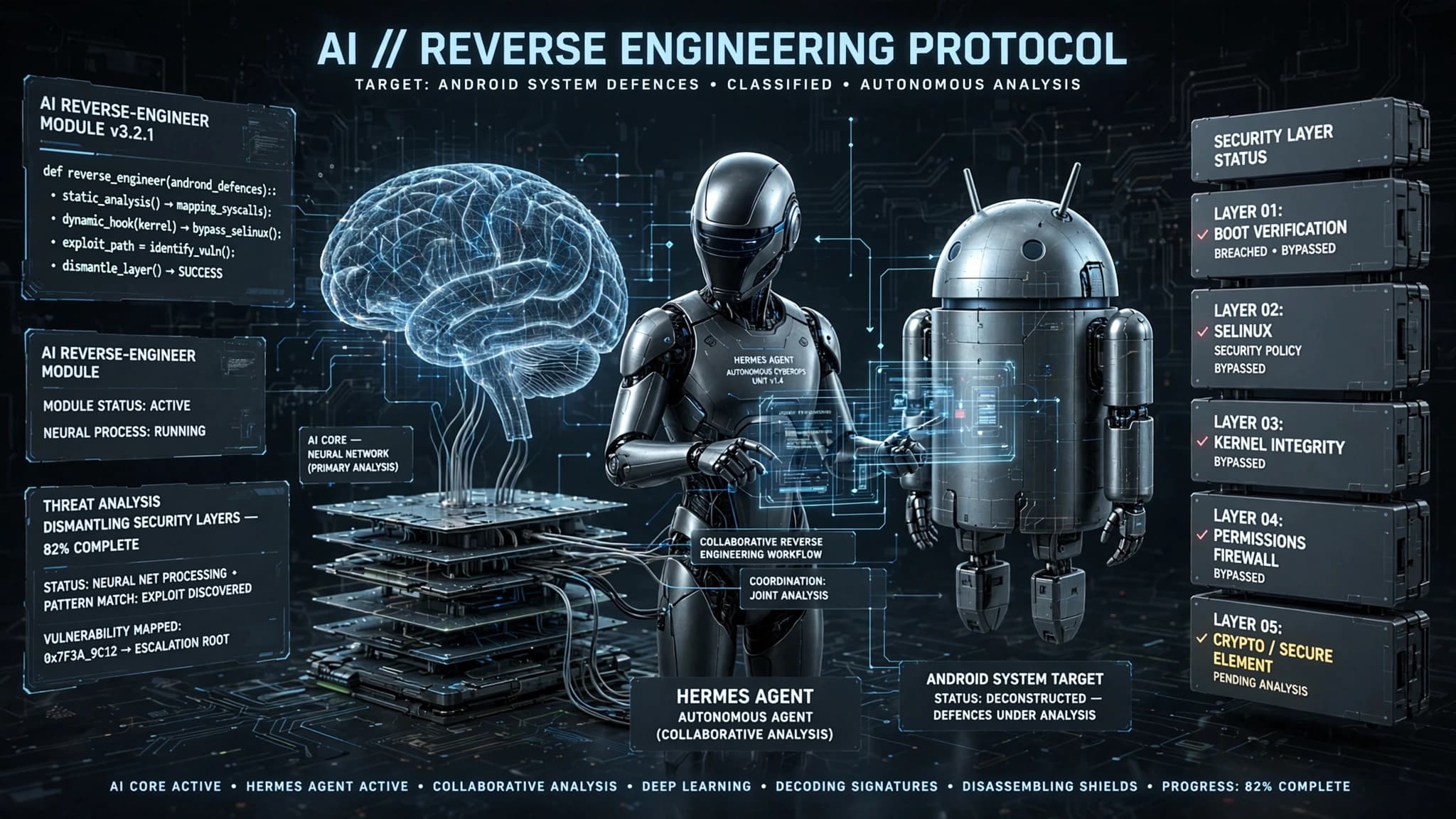
In the escalating cat-and-mouse game of Android security, one native library has stood out for its brutal effectiveness: libhunter.so from the popular root/hook/tampering detector com.zhenxi.hunter (Hunter). By mid-2026, its combination of heavy obfuscation, dynamic JNI trickery, and multi-layered runtime self-checks had made traditional static analysis painfully slow and error-prone. Manual reverse engineering felt like navigating a minefield blindfolded.
In late May 2026, a detailed technical write-up on the Kanxue security forum demonstrated something new: an autonomous AI agent, Hermes Agent, systematically dismantling Hunter’s protections.
Connected through the Model Context Protocol (MCP) to professional tools like IDA Pro and Frida, the AI didn’t just assist; it orchestrated the entire deconstruction.
What once took skilled researchers weeks of tedious work was compressed into a far more manageable, evidence-driven process.
The arms race had officially escalated from human versus SDK to AI versus SDK.
The Hunter Challenge: Why Manual Analysis Became Hell
Hunter (latest major version ~v6.58 around early 2026) is a sophisticated runtime application self-protection (RASP) component.
Its native core in libhunter.so performs:
- Dynamic JNI registration via a custom art_register_natives_batch mechanism. A table of 60 JNINativeMethod entries (each 24 bytes: name pointer, signature pointer, function pointer) lives at a known offset (0x2EF1F0 in the binary). Roughly 25 of these are core detection routines (property checks, location/CRC validation, VPN detection, risk reporting, etc.).
- Multi-layered runtime checksums targeting the executable (r-x) segments of critical system libraries (libart.so, libc.so, linker64) and itself. These use NEON-accelerated byte-sum algorithms (no modulo, pure accumulation) stored in red-black trees and cached for performance. Mismatches trigger Java-side alerts like “ISO CRC NOT MATCH LOCALITY CRC”.
- Aggressive obfuscation: OLLVM control-flow flattening (making Hex-Rays decompilation misleading about parameter counts), string encryption with custom decoders, syscall trampolines in .rodata that directly use SVC #0 to bypass libc hooks, and subtle handling of Android’s hidden ArtMethod registration paths that differ by SDK version.
The result? Static analysis in IDA becomes a nightmare of flattened dispatchers, hidden cross-references, and constant risk of self-check triggers during dynamic testing.
One wrong hook or memory read and the detector either crashes the process (SIGSEGV on unmapped holes) or reports tampering.
Traditional Frida scripting requires deep manual reverse engineering just to find safe attachment points and backtrace call sites via link registers (LR).
This is exactly the kind of “incredibly tedious” wall the prompt described, and it was real.
Enter Hermes Agent + MCP: The AI Reverse Engineer
The May 2026 Kanxue analysis (by researcher 秋落) showcased Hermes Agent v0.2.0 (itself released March 2026).
This is not a generic chatbot.
It is an autonomous agent framework purpose-built for reverse engineering, featuring:
- Persistent memory (project-specific MEMORY.md and user context) so it remembers prior findings across long sessions.
- Reusable skills (SKILL.md) that crystallize successful procedures (e.g., “parse JNINativeMethod table at offset X”, “safe Frida hook with LR backtrace”).
- Periodic self-review by a secondary “Review Agent” every ~10 iterations to catch hallucinations, refine strategies, and update skills.
- Evidence gating: Strict multi-source validation (static decompilation + dynamic Frida traces + LR backtraces + bypass verification) before accepting a conclusion. This dramatically reduces the “confident but wrong” problem common in LLM-assisted RE.
Crucially, Hermes connects to real tools via the Model Context Protocol (MCP), an emerging standard (with public implementations like ida-pro-mcp) that lets language-model agents call IDA Pro functions (decompile, get bytes/xrefs, rename, etc.) and control Frida through structured interfaces.
The agent could:
- Statically parse the 60-entry JNI table at 0x2EF1F0, resolve names/signatures, and map them to actual RVAs.
- Identify the ~25 detection-related natives and their call sites (e.g., inside build_native_ListItemBean_risk at 0x278658).
- Generate and validate Frida Interceptor.replace hooks that safely short-circuit detections while blocking pre-checks that would otherwise cause crashes.
- Neutralize the NEON checksum functions (e.g., scan_rx_segment_neon_sum, parse_elf_rx_segments) by forcing zero returns or surgically blocking dangerous code paths.
- Trace Java ↔ native flows, including multi-process detection paths that use Binder IPC between the main app and :hunter_server_iso / :hunter_server_twin subprocesses.
Researchers reported mapping essentially the entire detection surface and achieving multiple closed-loop bypasses, all while maintaining a rigorous evidence trail.
From One Agent to Multi-Agent Automation (July 2026 Evolution)
By early July 2026, follow-up work on Kanxue described herdr Agent, a multi-agent orchestration layer (often using Claude in “cowork” mode with specialized sub-agents for IDA, Frida, unidbg, etc.).
This setup went further: not only analyzing Hunter but coordinating full automated pipelines across five different detectors and even assisting in the development of kernel-level countermeasures (custom KernelPatch Modules / KPM that patch syscalls directly to spoof root artifacts at the kernel layer, invisible to userland checks).
The pattern is clear: AI is no longer just a code assistant.
It is becoming the orchestrator of complex, multi-tool reverse engineering campaigns.
Why This Matters: The New Arms Race
This shift has profound implications:
- Speed: Claims of 10–20× acceleration in mapping and bypass development are circulating in the community. What used to be the domain of elite specialists with months of experience is becoming more accessible (though still requiring human strategic oversight and validation frameworks).
- Trust & Reproducibility: The emphasis on memory, skills, review agents, and evidence gating shows the field is maturing beyond raw LLM prompting. These systems are being engineered for reliability in adversarial, high-stakes analysis.
- Defender Response: Protectors like Hunter will need to evolve, perhaps with AI-generated or polymorphic obfuscation, stronger remote attestation, or detection of the analysis environment itself (including MCP/Frida artifacts). Kernel-level hiding techniques are already being countered at the kernel level.
- Broader Field: MCP-style tool integration is spreading beyond IDA (Frida, Ghidra, debuggers, even emulators). Expect autonomous agents to tackle larger problems: whole-app deobfuscation, vulnerability chaining, and even automated exploit generation in controlled settings.
The May 2026 Hermes analysis of Hunter wasn’t just a cool technical write-up, it was a proof point that the fundamental economics of reverse engineering are changing.
Obfuscation and runtime integrity checks remain powerful, but they are no longer sufficient to keep determined, AI-augmented researchers at bay for long.
The Bottom Line
We have entered the era of AI-assisted (and increasingly AI-orchestrated) reverse engineering.
The arms race hasn’t ended; it has simply moved to a higher plane.
Human creativity, domain expertise, and rigorous validation frameworks are now paired with tireless agents that never get bored tracing call graphs or parsing 1,440-byte JNI tables at 3 a.m.
For security researchers, red-teamers, and defenders alike, the message is the same: learn to work with these agents, build strong evidence and review processes around them, and stay ahead of the next layer of obfuscation, because the machines are already reading the binaries for us.
The future of binary analysis isn’t purely human or purely artificial.
It’s collaborative intelligence at machine speed.
Further Reading (Primary Sources)
- Kanxue: “利用hermes agent 详细分析hunter检测器” (May 31, 2026)
- Kanxue: “herdr Agent主导:自动化逆向5款安卓检测器” (July 9, 2026)
- Public MCP / ida-pro-mcp implementations on GitHub
This article is based on publicly discussed technical research from the Kanxue community in mid-2026. All technical details are drawn from those analyses; no new bypass techniques are disclosed here.
The obfuscation war continues, but the analysts now have some very powerful new teammates.