Operation FACE: How India Built an AI-Powered Shield Against the Telecom Frauds
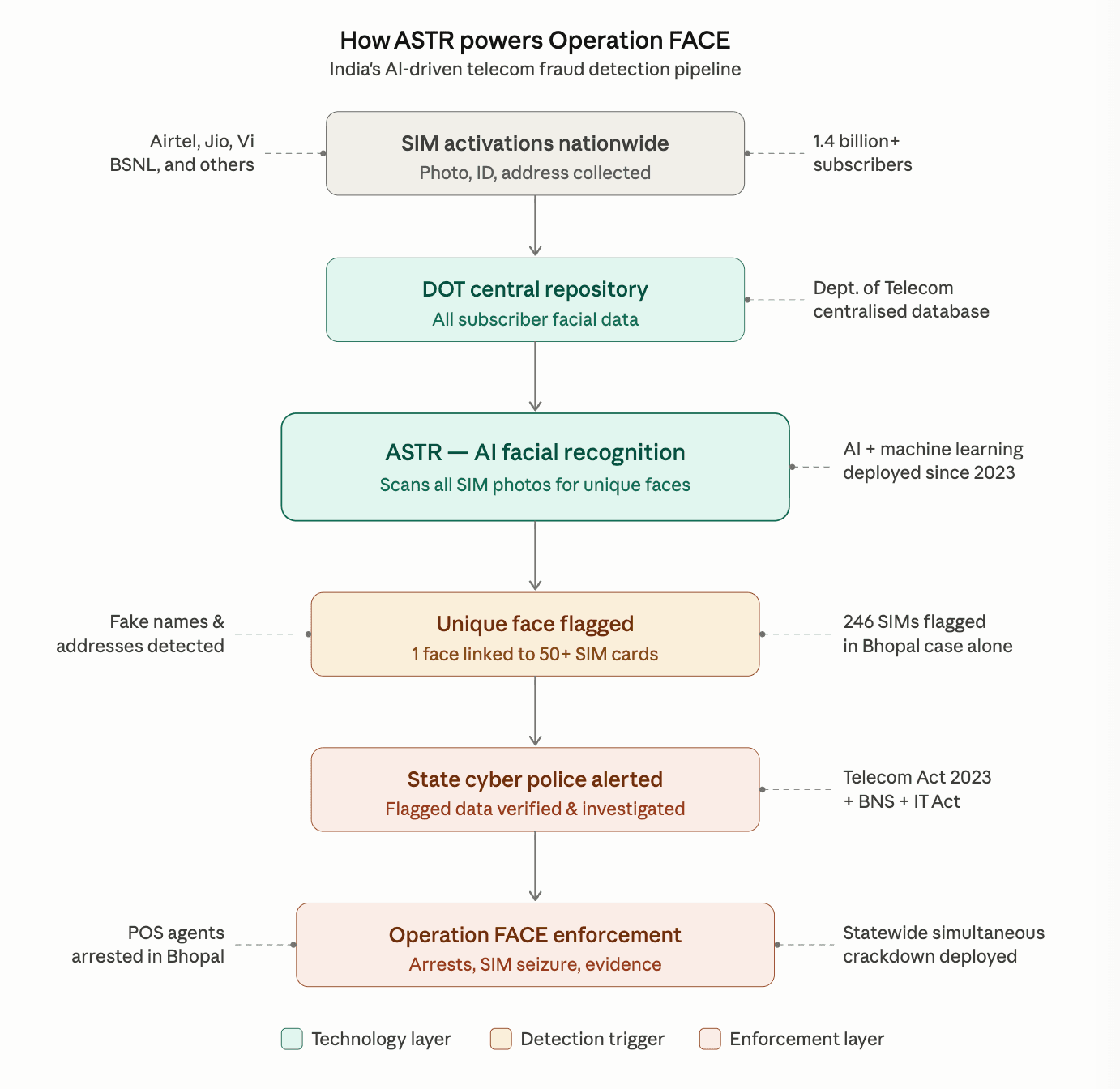
Bhopal, March 25, 2026, In a world drowning in SIM-based cybercrime, from OTP scams and financial fraud to identity theft and terror financing, India just demonstrated what decisive, technology-led policing looks like. The country has deployed a first-of-its-kind AI facial recognition dragnet called Operation FACE (Facial Authentication & Compliance Enforcement), and the results are staggering.
The Technology that made it Possible: ASTR
At the heart of Operation FACE lies a groundbreaking tool developed by India's Department of Telecommunications (DOT) in 2023, the AI-based Facial Recognition Tool called ASTR (Artificial Intelligence Solution for Telecom-Related fraud).
Here's how ASTR works:
ASTR scans the facial photographs submitted during SIM activation across every telecom operator in India. Using advanced AI and machine learning, it identifies "Unique Faces", single individuals whose face appears on 50 or more SIM cards registered under different names. That threshold isn't arbitrary. Legitimate users don't have 50 SIMs. Fraudsters do.
In this specific case, DOT's ASTR system flagged a single face linked to 246 activated SIM cards. The data was handed to the Rajya (State) Cyber Police Headquarters in Bhopal, which then launched a targeted investigation. The AI didn't just detect fraud, it handed investigators a precise, court-ready trail of evidence.

This is not a prototype. This is not a pilot programme. This is operational AI, running at national scale, processing millions of SIM registration records, catching patterns no human team could spot.
The Accused and Their Modus Operandi:
The two arrested POS agents reveal a disturbingly simple fraud model:
- Devendra Yadav (Age 34), resident of Barkhedi, Jahangirabad, Bhopal, POS Agent, verified 52 of the fraudulent SIMs.
- Mo. Saif Qureshi, resident of Islampura, Itwara Road, Bhopal, POS Agent, verified 3 of the fraudulent SIMs.
A third accomplice, Faizan, remains at large and is being actively pursued.
The Ground Team That Delivered Results:
The arrest and evidence seizure were executed by a dedicated team from the Cyber Crime Branch, District Bhopal, comprising Inspector Suresh Farkale, Sub-Inspector Pramod Sharma, Constables Javed Khan, Narendra Rajput, Balwan Singh, Nilesh Sahu, Ashok Sharma, Sunil Kumar, and Subham Chaurasiya. Their meticulous technical analysis and rapid fieldwork translated digital intelligence into physical arrests within days.
Legal Sections Invoked by Police:
India didn't just build the technology, it ensured the legal framework was equally formidable. The accused have been charged under a powerful combination of statutes:
- Section 20, Bharatiya Nyaya Sanhita (BNS), India's modernised criminal code provision addressing fraud and cheating
- Section 66, Information Technology Act, covering computer-related fraud and identity theft
- Sections 42(3)(e) and 42(6), Telecommunication Act 2023, India's newest telecom law, specifically designed to penalise fraudulent SIM activation, identity misuse in telecom services, and violations of subscriber verification norms
The invocation of the Telecommunication Act 2023 is particularly significant. This legislation was purpose-built to close the legal gaps that older laws couldn't address, giving investigators direct statutory authority over SIM fraud, something most countries still lack.
What the World Should Learn from India
Most countries are still fighting telecom fraud with outdated tools, reactive investigations, manual audits, and fragmented databases. India's Operation FACE offers a blueprint that the rest of the world would be wise to study and adapt.
- Build AI Into the Regulatory Infrastructure, Not Just the Police Toolkit. India didn't wait for police departments to adopt AI on their own. The Department of Telecommunications built ASTR at the national level and embedded it into the telecom licensing and compliance architecture. This means every SIM activated in India is now subject to AI-driven facial verification, automatically, continuously, at scale. Countries still relying on manual KYC audits are fighting a 21st-century war with 20th-century weapons.
- Legislate Specifically for Telecom Fraud. India's Telecommunication Act 2023 didn't just modernise old rules, it created entirely new offences tailored to the SIM fraud ecosystem. Sections 42(3)(e) and 42(6) give prosecutors direct, unambiguous authority to charge fraudulent SIM activation. Most nations still force prosecutors to shoehorn SIM fraud into generic identity theft or forgery statutes, resulting in weaker cases and lighter sentences.
- Coordinate Nationally, Execute Locally. Operation FACE was designed at the state cyber police headquarters but executed simultaneously across an entire state. The intelligence was centralised (DOT's ASTR data), the strategy was unified (Operation FACE protocols), but the arrests were local, carried out by district-level cyber crime teams who understood their terrain. This hub-and-spoke model is the gold standard for scaling enforcement.
- Make Compliance Proactive, Not Reactive. The very name, Facial Authentication & Compliance Enforcement, signals a shift from reactive investigation to proactive compliance. India is not waiting for a SIM to be used in a crime before acting. It is identifying fraudulent SIMs at the point of activation and neutralising the threat before the damage is done. This preventive philosophy is something every telecom regulator in the world should adopt.
- Empower Citizens with Transparency Tools. By making the Sanchar Saathi portal publicly accessible, India has given every citizen the power to audit their own telecom identity in real time. How many SIMs are on my Aadhaar? Who activated them? Where? This level of transparency turns 1.4 billion citizens into a distributed fraud detection network, something no government agency, however well-resourced, can replicate alone.
Leadership and Command Structure:
- Sanjay Singh, Commissioner of Police (CP), Bhopal, provided the overarching strategic mandate
- Smt. Monika Shukla, Additional Commissioner of Police (Crime & Headquarters), directed the operational framework
- Akhil Patel, Deputy Commissioner of Police (DCP), Crime, supervised the investigative thrust
- Shailendra Singh Chauhan, Additional DCP, provided on-ground coordination
- Sujeet Tiwari, Assistant Commissioner of Police (ACP), Cyber, led the day-to-day direction of the cyber crime team
The question for every other country is no longer whether they should follow this success model. It is how quickly they can.
Sources
- gwalior.mppolice.gov.in
- timesofindia.indiatimes.com
- freepressjournal.in