Insights from India's AI Adoption in Government Ministries and Departments
The Committee examined challenges such as job displacement, algorithmic bias, data privacy concerns (under the Digital Personal Data Protection Act), copyright issues, need for comprehensive AI legislation, deepfake proliferation, cyber financial frauds using AI, illegal immigration detection, and the lack of consensus on defining autonomy of weapon systems.
Twenty-Seventh Report of the Standing Committee on Communications and Information Technology (2025-26), Eighteenth Lok Sabha was presented to Parliament on 30th March, 2026. The Committee is chaired by Dr. Nishikant Dubey and comprises 21 Lok Sabha and 10 Rajya Sabha members.
The report examines the impact, adoption, governance, and challenges of AI across multiple arms of the Government of India. The Committee heard depositions from representatives of various Ministries over multiple sittings held between January 2025 and January 2026
A. MeitY (Ministry of Electronics and Information Technology)
The central ministry driving AI policy. Key highlights include the IndiaAI Mission (approved March 2024, with a budget outlay of ₹10,372 crore over five years), comprising pillars like:
- IndiaAI Compute Capacity
- Innovation Centre
- Datasets Platform (AIKosh with 10,000+ datasets)
- FutureSkills (targeting PhD fellows, undergrad/postgrad students, and 570 Data & AI Labs in Tier 2/3 cities)
- Startup Financing
- Safe & Trusted AI
The Ministry also released the India AI Governance Guidelines (November 2025) built around seven guiding principles (Sutras) and six governance pillars, along with regulatory steps on deepfakes and synthetically generated information under IT Rules, 2021.
B. Ministry of New and Renewable Energy (MNRE)
AI applications in the renewable energy sector.
C. Ministry of Finance
Covers AI use across the Department of Financial Services (fraud detection, mule account identification), Department of Revenue, Directorate of Enforcement, CBDT (AI in tax filing and the IEC 3.0 project), and CBIC (Generative AI for taxpayer grievance redressal and training).
D. Ministry of Home Affairs
A major focus area. The Indian Cyber Crime Coordination Centre (I4C) leads AI adoption for cybercrime detection and investigation. Key initiatives include:
- NCRP-CFCFRMS platform (onboarding 431 banks and other financial entities)
- Cyber Fraud Mitigation Centre (CFMC)
- SAHYOG Portal for automated content takedown notices
- SURAKSHINI for protecting women and children online
- 1930 cybercrime helpline with planned AI-assisted complaint registration
- Mule Hunter AI/ML tool (with RBIH collaboration)
- Dark web monitoring
- Proactive Monitoring Tool for CSEAM content
- Cyber Commandos Programme (target: 5,000 trained commandos over five years)
The report also touches on AI for facial recognition, ANPR, counter-terrorism, and border security.
E. Ministry of Defence and DRDO
AI projects spanning C4ISR systems, autonomous/unmanned systems, intelligent monitoring, predictive maintenance, speech/voice analysis using NLP, and generative AI-based virtual assistants. The Committee discussed risks and benefits of AI in lethal autonomous weapon systems.
F. Ministry of Power
AI in demand forecasting, grid optimization, renewable energy integration, predictive maintenance, energy theft detection, and solar panel inspection. The draft National Electricity Policy, 2025 includes data centre demand in electric power surveys.
G. Department of Legal Affairs
Legal implications and frameworks for AI governance.
H. Department of Agriculture and Farmers Welfare
AI applications in farming and agricultural decision-making.
I. Ministry of Tourism
AI adoption in the tourism sector.

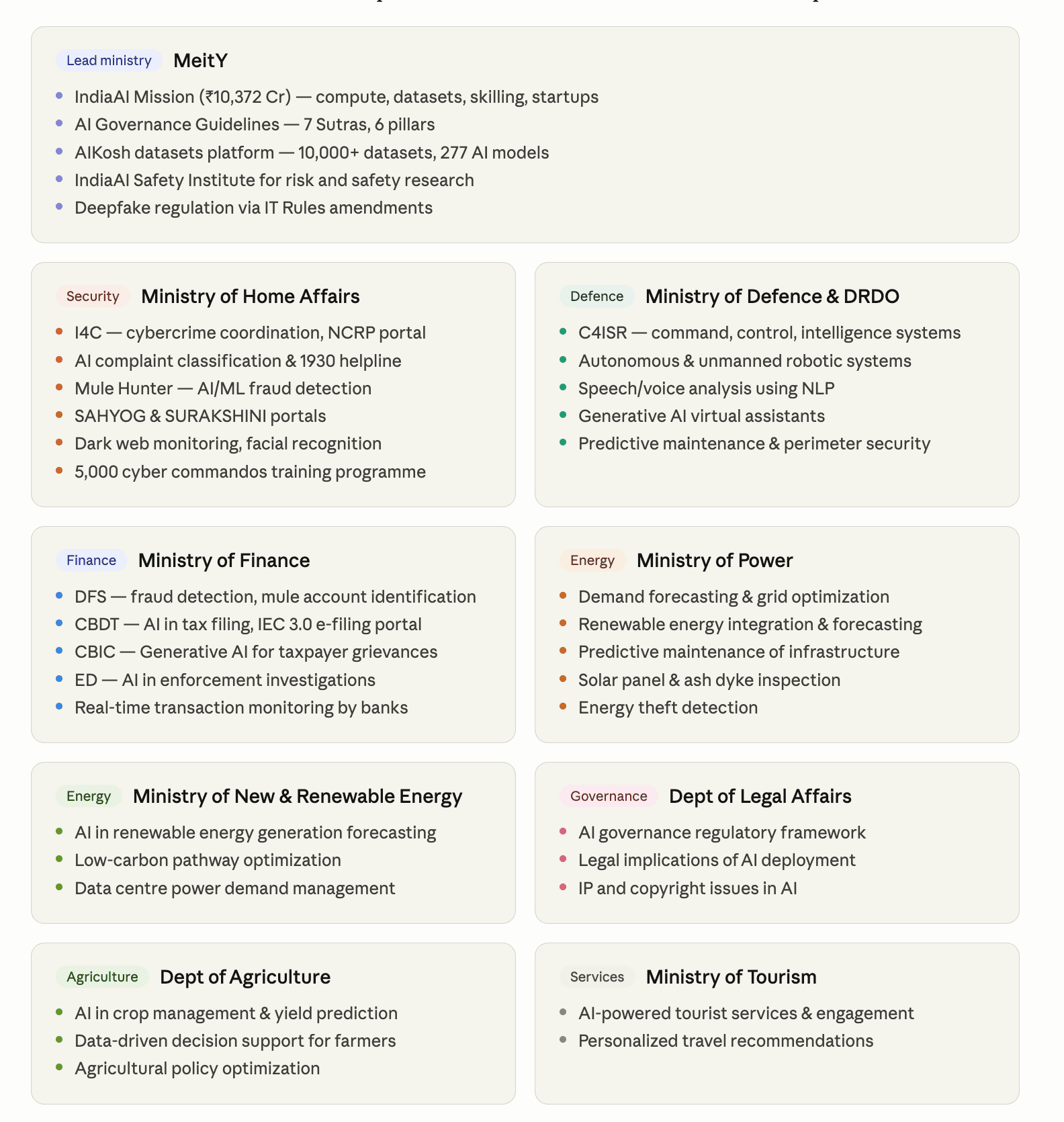
The graphic maps out the AI use cases across all nine Ministries and Departments examined in the report. MeitY sits at the top as the lead ministry driving the overall IndiaAI Mission, while the other ministries are applying AI within their specific domains, from cybercrime detection (MHA) and autonomous defence systems (MoD/DRDO) to grid optimization (Power) and fraud prevention (Finance).
AI adoption is broadest in security and finance-related ministries, while departments like Legal Affairs and Tourism are still in earlier stages of integration.
Sources
- sansad.in
- prsindia.org