India Tightens the Screws on Organised Cybercrime: MCOCA Invoked Against SE Asia linked Investment Scam Gang
The Maharashtra Control of Organised Crime Act, 1999 was the first state law in India aimed specifically at organised crime. Originally enacted to tackle the Mumbai underworld, it came into force on 24 February 1999 and today extends to the State of Maharashtra and the National Capital Territory of Delhi.
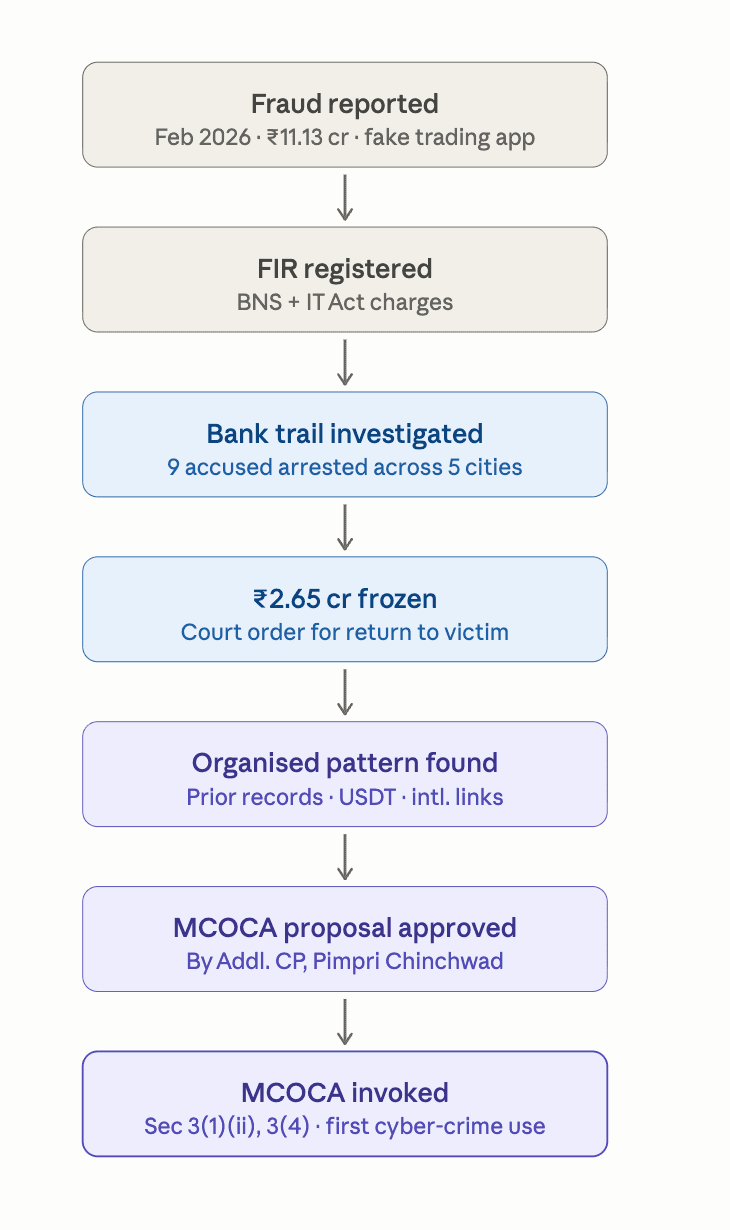
In a move that signals a decisive shift in how Indian law enforcement is treating large-scale digital fraud, the Pimpri Chinchwad Police Commissionerate has, for the first time, invoked the Maharashtra Control of Organised Crime Act (MCOCA) against a cybercrime syndicate. Nine accused, operating across Maharashtra and Rajasthan, have been booked under the stringent law after being linked to an ₹11.13 crore investment-fraud targeting a retired senior citizen.
Stock Trading - Investment Scam linked to Scam Compounds of SE Asia
On 20 February 2026, a senior citizen approached the Cyber Police Station, Pimpri Chinchwad, alleging he had been defrauded of ₹11 crore 13 lakh through a bogus trading application that promised outsized returns on share-market investments. The FIR (Cr. No. 05/2026) was registered under sections 338, 318(4), 316(2) and 3(5) of the Bharatiya Nyaya Sanhita and sections 66(A) and 66(D) of the Information Technology Act.
During the investigation, police traced the layered transfer of the defrauded money across multiple bank accounts and froze ₹2 crore 65 lakh 76 thousand, for which a court order has been obtained to return the amount to the complainant.
The trail led investigators to Kolhapur, Pune, Dahisar (Mumbai), Aurangabad and Udaipur (Rajasthan), from where nine accused were arrested. A check of their antecedents revealed multiple prior cases against each of them, the kind of repeat-offender profile MCOCA was designed for.
Modus Operandi
According to the police, the gang built an organised network that used social-media platforms to float fake investment schemes, luring ordinary citizens with the promise of abnormally high returns. Defrauded amounts were routed through mule bank accounts and then converted into USDT (Tether), a cryptocurrency, to move the money across borders to international handlers. The commissionerate has said the syndicate's activity spanned Pimpri Chinchwad, Mumbai and Madhya Pradesh, and that the use of abstract digital currency posed a threat to the financial system itself.

On a proposal submitted by Senior PI Ravikiran Nale of the Cyber Police Station, Additional Commissioner of Police Sarang Awad approved the addition of sections 3(1)(ii) and 3(4) of the MCOCA, 1999. The operation was carried out under the overall supervision of Police Commissioner Vinay Kumar Chaube.
India's Hardening Stance Against Organised Crime
Indian law enforcement has, over the last few years, moved from treating cyber fraud as isolated cheating offences to recognising them as organised crime, typically planned, hierarchical, transnational, and profit-driven. The newly enforced Bharatiya Nyaya Sanhita itself introduces a dedicated offence of organised crime (Section 111), and states like Maharashtra, Gujarat, Karnataka, Uttar Pradesh and Haryana now have their own anti-organised-crime statutes. Applying MCOCA to a purely digital fraud gang, rather than the traditional underworld, extortion or contract-killing cases it was built for, marks an important evolution in that approach.
A Brief on MCOCA
The Maharashtra Control of Organised Crime Act, 1999 was the first state law in India aimed specifically at organised crime. Originally enacted to tackle the Mumbai underworld, it came into force on 24 February 1999 and today extends to the State of Maharashtra and the National Capital Territory of Delhi.
MCOCA defines an organised crime syndicate as a group of two or more persons engaged in continuing unlawful activity, using violence, threat, coercion or other unlawful means, to gain pecuniary or undue economic advantage. It gives police several powers unavailable under ordinary criminal law, including:
- 1. Interception of wire, electronic and oral communications with prior authorisation
- 2. Admissibility of confessions made to a police officer of DCP rank or above (a departure from the general rule under the Indian Evidence Act)
- 3. Extended periods of police custody and stricter bail conditions
- 4. Trial by Special Courts, with provisions for in-camera proceedings and witness protection
- 5. Forfeiture and attachment of property acquired through organised crime
- 6. Penalties ranging up to life imprisonment and, in cases involving death, the death penalty
The statute also overrides conflicting provisions in other laws, and requires prior approval of a senior police officer before an FIR under the Act can be registered, a safeguard intended to prevent routine misuse.
Why This Matters
Cyber frauds of this scale have typically been investigated under the IT Act and cheating provisions, where bail is easier and syndicates can regroup quickly. Bringing MCOCA into play raises the legal cost of running such operations significantly, longer custody, stringent bail, admissible confessions, and attachment of proceeds. For victims of investment scams, which have multiplied sharply with the rise of fake trading apps, it also signals that the state is prepared to treat digital economic offences with the same gravity once reserved for traditional organised crime.
Based on a press note issued by the Public Relations Office, Crime Branch, Pimpri Chinchwad Police Commissionerate, dated 18 April 2026.
Sources
- indianexpress.com
- timesofindia.indiatimes.com
- freepressjournal.in