India Is Quietly Building the Blueprint for a Safer Internet, detecting DNS Abuse before damage
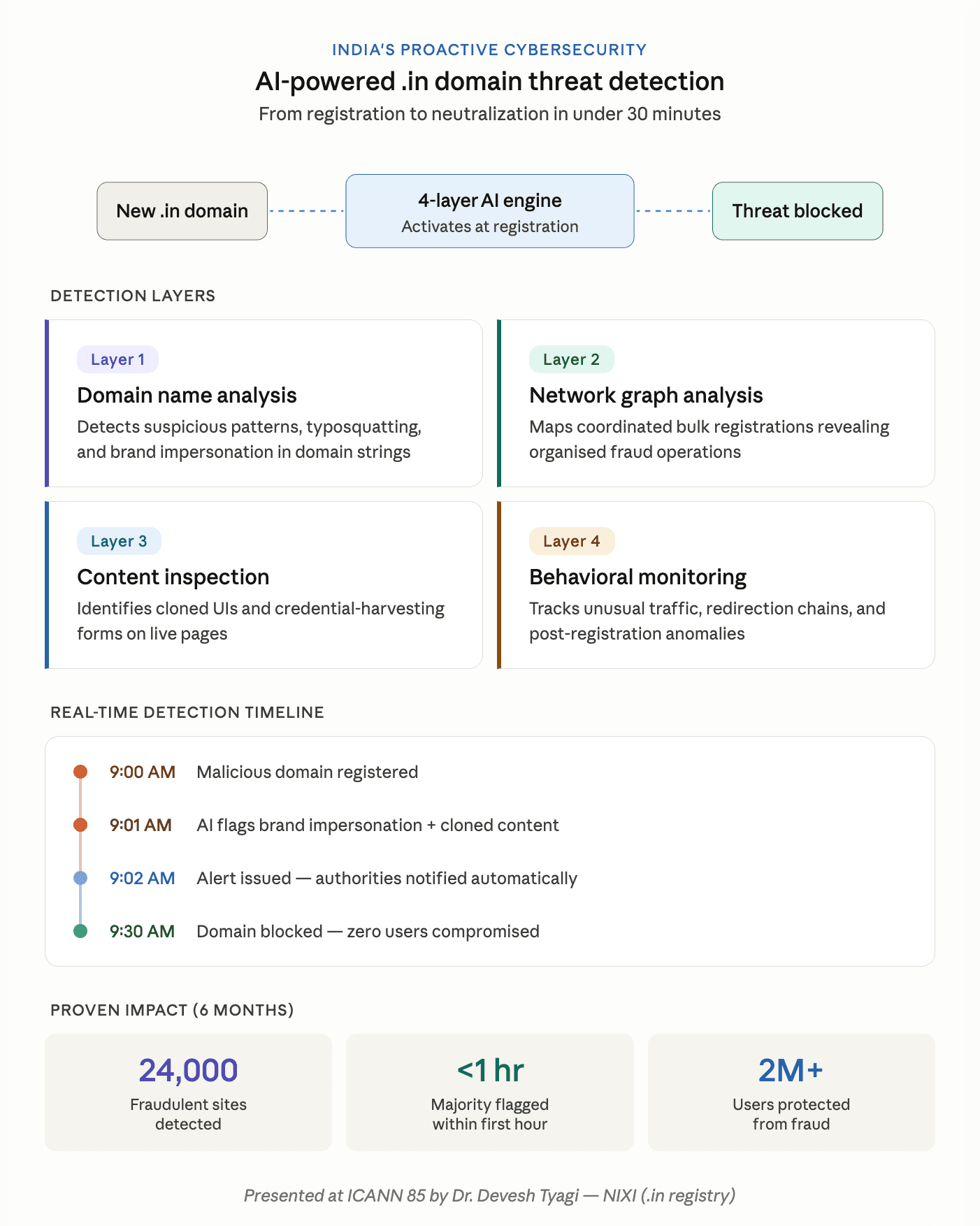
How a country of 1.4 billion is turning its national domain into a model for proactive cybersecurity for securing its ".in" domain space.
MUMBAI, While much of the world still fights cybercrime by chasing it, India is doing something quietly revolutionary: stopping it before it starts.
At the heart of this shift is NIXI, the National Internet Exchange of India, and its stewardship of the .in country-code top-level domain (ccTLD), one of the fastest-growing national domains in the world. With roughly 3,000 new .in domains registered every day, India faces a scale of challenge that most nations haven't yet had to confront. Rather than buckle under it, India has turned that pressure into innovation.
An AI-First Approach to Domain Security
Under the leadership of figures like Dr. Devesh Tyagi, who recently presented India's approach at ICANN 85, the premier global forum for Internet governance, India has deployed a four-layer AI-powered detection engine that activates at the moment of domain registration, not days or weeks later.
The system works in stages:
- The first layer analyses the domain name itself, scanning for patterns associated with brand impersonation, think "sbi-logins-secure.in" or "paytm-offers-india.in."
- The second layer maps network relationships, identifying coordinated bulk registrations that signal organised fraud operations rather than isolated incidents.
- A third layer inspects the actual content hosted on newly registered domains, flagging cloned user interfaces and credential-harvesting forms.
- The fourth layer monitors behaviour over time, unusual traffic spikes, suspicious redirection chains, and other signals that distinguish a genuine website from a trap.
What's remarkable is the speed. In a documented case, a malicious domain registered at 9:00 AM was flagged by 9:01, an alert was issued by 9:02, and the domain was blocked by 9:30, with zero users compromised.

SCALE:
Over a six-month period, this system identified approximately 24,000 fraudulent websites operating under the .in namespace. The majority were flagged within the first hour of their creation. An estimated two million users were shielded from potential fraud during that window.
One case study stands out in particular: 143 fake websites impersonating the State Bank of India, the country's largest public sector bank, were identified and neutralised before a single victim was targeted. For a nation where digital banking adoption has surged thanks to UPI and Jan Dhan Yojana, protecting that trust isn't just a cybersecurity matter. It's an economic imperative.
More Than Technology, A Governance Philosophy
What India is demonstrating isn't just technical capability. It's a philosophical shift in how nations can think about their responsibilities as stewards of their digital namespaces.
Traditionally, ccTLD management has been largely administrative, a registry function focused on availability, pricing, and compliance. India is redefining that role as one of active guardianship. The .in domain isn't just a product to be sold; it's a piece of national digital infrastructure to be protected.
This aligns naturally with India's broader digital public goods strategy, the same thinking behind Aadhaar, UPI, and the India Stack. The pattern is consistent: build scalable digital infrastructure, then layer intelligent protections on top rather than treating security as an afterthought.
The roadmap ahead includes pre-registration detection, where suspicious patterns are flagged even before a domain goes live, as well as expansion beyond .in to collaborate on threat intelligence across global TLDs.
What the World Can Learn
India's approach arrives at a moment when the global Internet governance community is grappling with hard questions about how to balance openness with safety. Several lessons from the Indian model deserve wider attention.
- Scale demands automation, not just more staff. Countries with high volumes of domain registrations cannot rely on manual review or complaint-driven takedowns. India's experience shows that AI-powered systems can operate at the speed and scale the problem demands, without proportionally increasing costs.
- Proactive beats reactive. The window between a fraudulent domain going live and it being reported is where all the harm happens. Closing that window, ideally to minutes rather than days, is the single highest-impact intervention a registry can make. India's detection pipeline demonstrates this is technically achievable today.
- Collaboration is the Key. Cyber fraud doesn't respect borders. A phishing site targeting Indian bank customers may be accessed from anywhere in the world. India's push toward cross-border collaboration and expanding beyond .in to global TLDs acknowledges that national solutions, however effective, are only part of the answer.
- Trust is infrastructure. For countries pursuing financial inclusion and digital transformation, as dozens across the Global South are, public confidence in the safety of online transactions is not a luxury. It's a prerequisite.
The global Internet governance community meets regularly through ICANN, the IGF, and regional forums to shape policies that affect how the Internet functions for billions of users. India's contributions to these discussions are increasingly informed by operational experience at a scale few countries can match.