Cambodia's resturant chain owner arrested by Indian Cyber Police for involvement in illegal recruitment
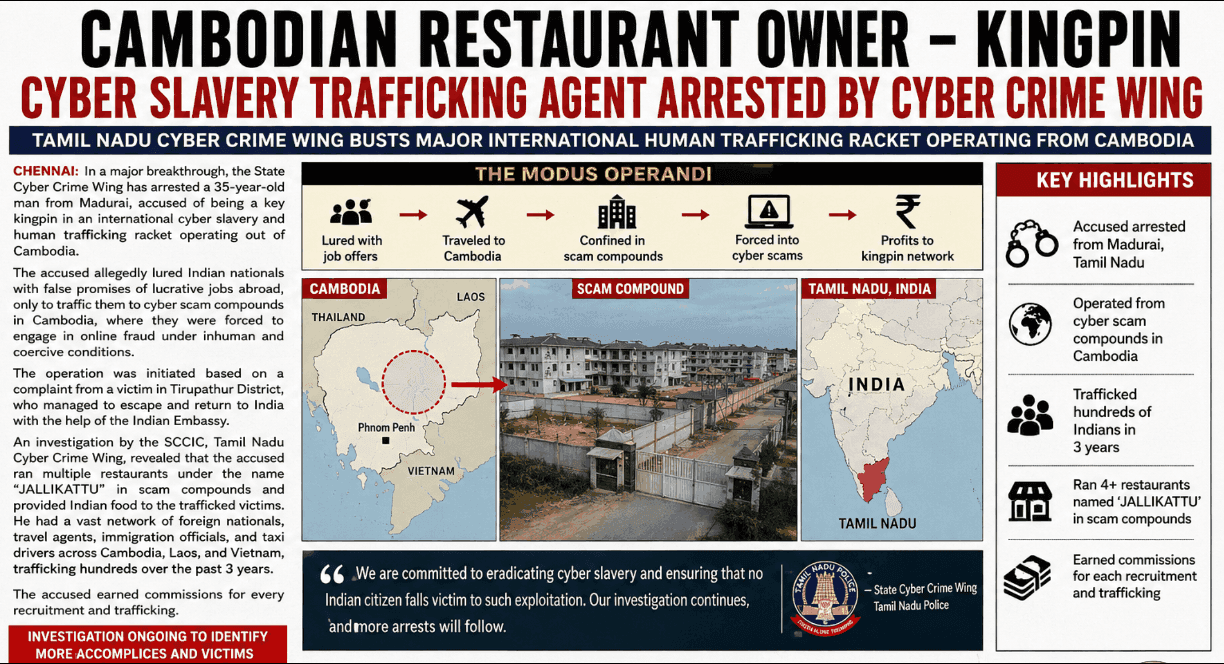
The arrest of a 35-year-old Indian national in Madurai this week has exposed a telling artefact of Southeast Asia's cyber-slavery economy: an Indian restaurant chain operating inside the scam compounds themselves, allegedly doubling as logistical backbone for the trafficking of hundreds of Indian victims into forced online fraud.
Chennai / Bangkok / New Delhi, 18 May 2026
The Tamil Nadu State Cyber Crime Wing announced the arrest of Madhan Vadivel, described in its 18 May press release as a "kingpin recruiter and facilitator of Cyber Slavery trafficking", following a complaint by an escaped victim from Tirupathur District. Investigators say the accused ran more than four restaurants under the name "JALLIKATTU" sited within cyber-scam compounds in Cambodia, supplying Indian food to trafficked victims while running an international recruitment network spanning travel agents, taxi operators, and immigration contacts across Cambodia, Laos, and Vietnam.
A regional crisis with a global footprint
The United Nations Office on Drugs and Crime (UNODC), in its April 2025 report Inflection Point: Global Implications of Scam Centres, Underground Banking and Illicit Online Marketplaces in Southeast Asia, concluded that the region's scam-compound economy has matured into a transnational criminal ecosystem fusing cyber-enabled fraud, underground banking, and industrial-scale human trafficking. INTERPOL assesses that roughly 74 per cent of known victims trafficked into scam centres between 2020 and 2025 were moved into Southeast Asia, drawn from more than 50 countries.
The recruitment script is now familiar: a polished social-media advertisement promising customer-service, IT, or marketing work; staged interviews; a plane ticket; and, on arrival, confiscation of the passport and consignment to a guarded compound where 14- to 16-hour days of romance fraud, crypto schemes, and investment scams are extracted under threat of violence.
India's exposure, and its response
India sits among the most heavily targeted source countries, with nationals documented in compounds across Myanmar's Myawaddy region, Cambodia's Sihanoukville, Bavet and Poipet, and Lao PDR's Bokeo Special Economic Zone. Through 2025, the Ministry of External Affairs (MEA) mounted one of the largest sustained repatriation efforts undertaken by any source government: 549 nationals flown home by the Indian Air Force in March from the Myanmar–Thailand border, a further 270, including 26 women, repatriated from Mae Sot in November, and additional batches throughout the year.
The Madurai arrest reflects the second prong: domestic prosecution of the recruiters who feed the pipeline. The Central Bureau of Investigation (CBI) has previously charged Indian agents Soyal Akhtar and Mohit Giri over trafficking into Myanmar's KK Park compound, both facing potential life sentences. The Tamil Nadu case extends that line of accountability into the support infrastructure, the caterers, fixers, and ground-handlers without whom the compounds could not retain their captive workforces.
According to the Cyber Crime Wing, Vadivel allegedly trafficked hundreds of victims over three years, collecting commissions on each recruitment. Mobile phones, SIM cards, and passport documents have been seized; the financial trail and the network of foreign compound operators are now under investigation.
Why the "JALLIKATTU" detail matters
The restaurant chain is an operationally significant finding. The scam-compound economy is sustained not only by principal scam operators but by a constellation of ancillary services, food, transport, document fixing, recruiting, that allow compounds to function as semi-autonomous prison-workplaces. A trafficker who is also the cook, the recruiter, and the airport contact represents a single node whose removal disrupts multiple flows.
That an Indian-run kitchen network was sustainable across "various cyber scam compounds" for "the past few years," as the Cyber Crime Wing puts it, points to the degree of institutionalisation these compounds have achieved.
The Madurai arrest will be measured by what follows it: the financial-flow tracing, the identification of additional victims, and the international cooperation needed to reach the foreign compound operators. For now, it stands as one of the more substantive source-country prosecutions yet recorded against the cyber-slavery economy, and as evidence that the architecture of these compounds, including their kitchens, is beginning to come into focus.
Sources: Tamil Nadu Cyber Crime Wing Press Release No. 05/2026 (18 May 2026); UNODC, "Inflection Point" (April 2025); Ministry of External Affairs, Government of India; Central Bureau of Investigation; INTERPOL.
Sources
- thehindu.com
- dtnext.in
- newsonair.gov.in