10,000 Fake SIM Cards: Inside CBI's Crackdown on India's Cybercrime Supply Chain
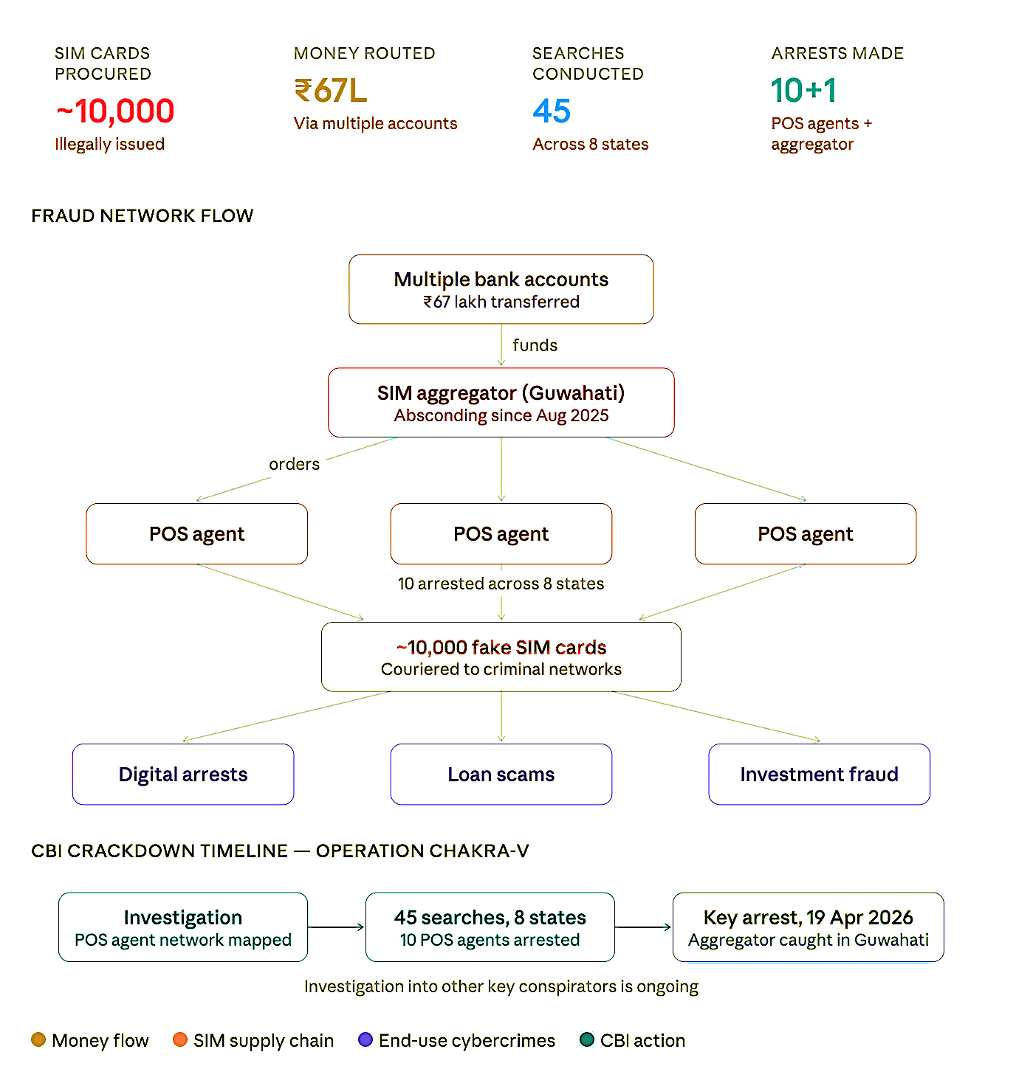
A single accused. Multiple bank accounts. Approximately ₹67 lakh in transactions. And an estimated 10,000 illegally procured SIM cards feeding a sprawling cybercrime network across India - industrialised SIM card abuse crackdown
20th April, 2026
Every major cybercrime, fake digital arrests, loan scams, investment frauds, has one thing in common: a mule SIM card. These SIM cards are the first link in any cybercrime across the world. In this single case busted by CBI, roughly 10,000 SIM cards were procured through compromised Point of Sale (POS) agents, using forged or stolen subscriber documents. These cards were then distributed to criminal networks operating across the country.
The accused, Ubaid Ullah, was arrested from Guwahati in the early hours of April 19 after remaining absconding since August 2025.
The sheer volume, ten thousand SIMs from one aggregator alone, suggests this is not a fringe activity. It is a well-organised parallel economy where SIM cards are a commodity, traded in bulk, shipped via courier, and funded through layered bank transfers designed to obscure the money trail.
Chakra - V
This operation is part of the CBI's broader strategy to dismantle cybercrime not case by case, but by attacking its supply chain. By going after SIM card aggregators and rogue POS agents, the agency is attempting to cut off the oxygen that fuels fraud networks at scale.

Under Operation Chakra-V, the CBI has been systematically targeting the enabling infrastructure of cybercrime rather than chasing individual fraud cases. In this phase of the operation, the agency conducted searches at approximately 45 locations across eight states, leading to the arrest of 10 accused POS agents involved in issuing fake or illegally procured SIM cards. The key conspirator, an aggregator based in Guwahati who had been absconding since August 2025, was traced and apprehended on April 19, 2026.
Investigation revealed that the accused used multiple bank accounts to route approximately ₹67 lakh to POS agents, along with courier-based delivery networks to receive the fraudulent SIM cards. The investigation into other key conspirators remains ongoing.
A Strategy for Cracking Down on SIM Abuse
Addressing SIM card fraud at its root requires a multi-layered approach:
- Biometric verification at point of sale. Encourage Aadhaar-based biometric authentication, with "Liveness Detection", eliminates forgery.
- Cap and monitor POS agent activity. Set daily and monthly limits on the number of SIM activations per POS agent. Flag anomalies, such as a single agent activating hundreds of SIMs in a short window, for automatic investigation.
- Telecom-bank data linkage. Create a shared intelligence framework between telecom providers and banks so that bulk SIM procurement funded through suspicious financial flows can be detected early.
- Accountability for telecom operators. Hold telecom companies jointly responsible for SIMs activated through their distribution chain without proper KYC. Financial penalties and licence conditions can drive self-regulation.
In the end, a coordination-operational relationship with various Agencies like DoT, I4C, State and Centre Police Agencies and LSAs to dismantle the criminal infrastructure at scale.